ALEXANDRIA, La. (UrbanCast: 6/26/2026) — By mid-morning Friday, the tents were gone.
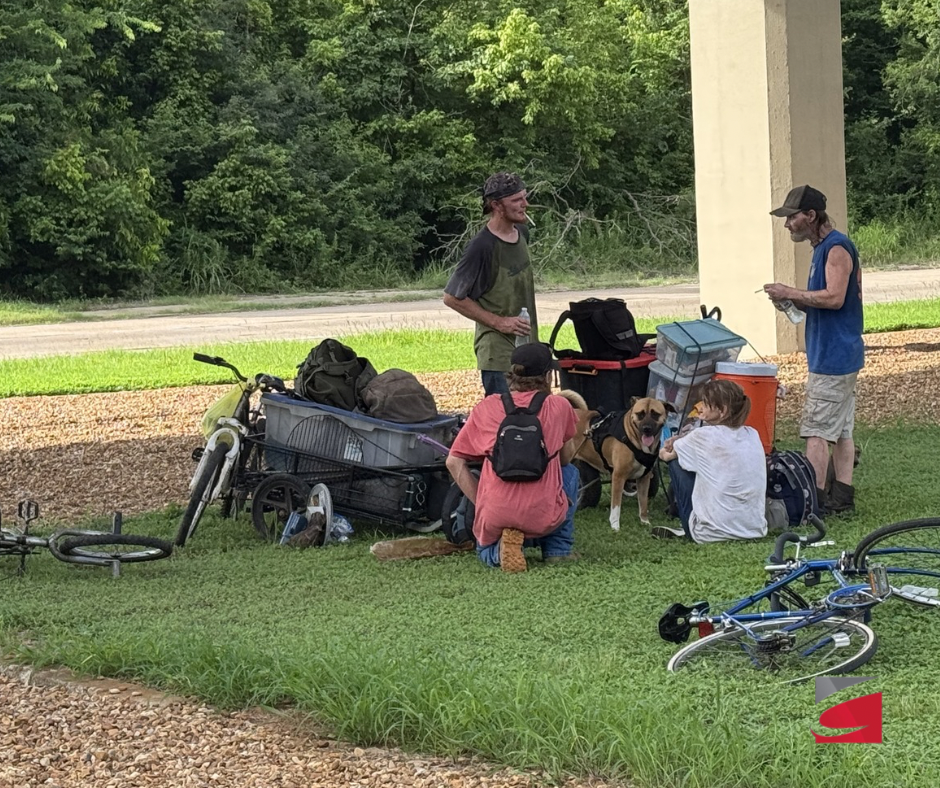
A small group of displaced residents sat beneath the Interstate 49 overpass surrounded by plastic storage bins, backpacks, bicycles, coolers, and the few belongings they had managed to save.

Dogs never wandered far from their owners as people sorted through what remained.
Just beyond them, bulldozers continued clearing the wooded encampment where several people had been living only hours earlier. Dumpsters filled with debris while former residents stood quietly nearby.
Several people said photographs, keepsakes, and clothing they could not carry were destroyed as crews cleared the site.
Animal Control officers responded during the operation and attempted to collect pets. Several residents hurried to secure their dogs before leaving.
There were no raised voices.
There were no protests.
Most simply watched.
Then they talked.

How Quickly Life Can Change
One conversation turned to how quickly life can change.
“It doesn’t matter,” one man said. “One drop of alcohol, you can become an addict. You’re not exempt from medical problems. You’re not exempt from mental health. You’re not exempt from addiction.”
Another person quietly replied.
“Nobody’s perfect.”
The conversation drifted from addiction to illness, disability, job loss, and loss.
One resident spoke about a man waiting on a disability determination who struggles to read well enough to complete paperwork on his own.
Another described living with chronic pain and severe nerve damage.
Others talked about friends who suffered heart attacks, lost spouses, or could no longer afford housing after losing income.
One woman looked toward the bulldozers.
“You told to pack your stuff,” she said. “This is all they get out with.”
She looked at the bins stacked nearby.
“This is what they get out with.”
She estimated some people had lived there for years.
“You don’t pack up four years in one day.”

Another resident spoke about family photographs and memories they believed were gone forever because there was no way to carry everything away.
Nearby, others checked on friends, shared bottled water, and made sure every dog had been accounted for before leaving.
At 11 a.m.
At 11 a.m., as the cleanup concluded, Alexandria Police Chief Chad Gremillion said the encampment had become a public safety and public health concern. He said officers provided advance notice before the operation and that transitional housing resources are available, though individuals must complete intake steps before entering those programs. It was unclear Friday how many beds were currently open or how quickly someone could access them.
Mayor Jacques Roy said homelessness cannot be solved through law enforcement alone. He described the issue as involving public safety, public health, mental health, addiction, housing, and quality of life, and called for a coordinated response involving government agencies, healthcare providers, nonprofits, churches, and community organizations.
The briefing explained why the city acted.
It did not answer what comes next for the people who were there.
Some loaded bicycles.
Some pulled luggage.
Some simply started walking.
No one seemed certain where they would spend the night.
By afternoon, the bulldozers had finished their work.
The tents were gone.
The people were gone, too.