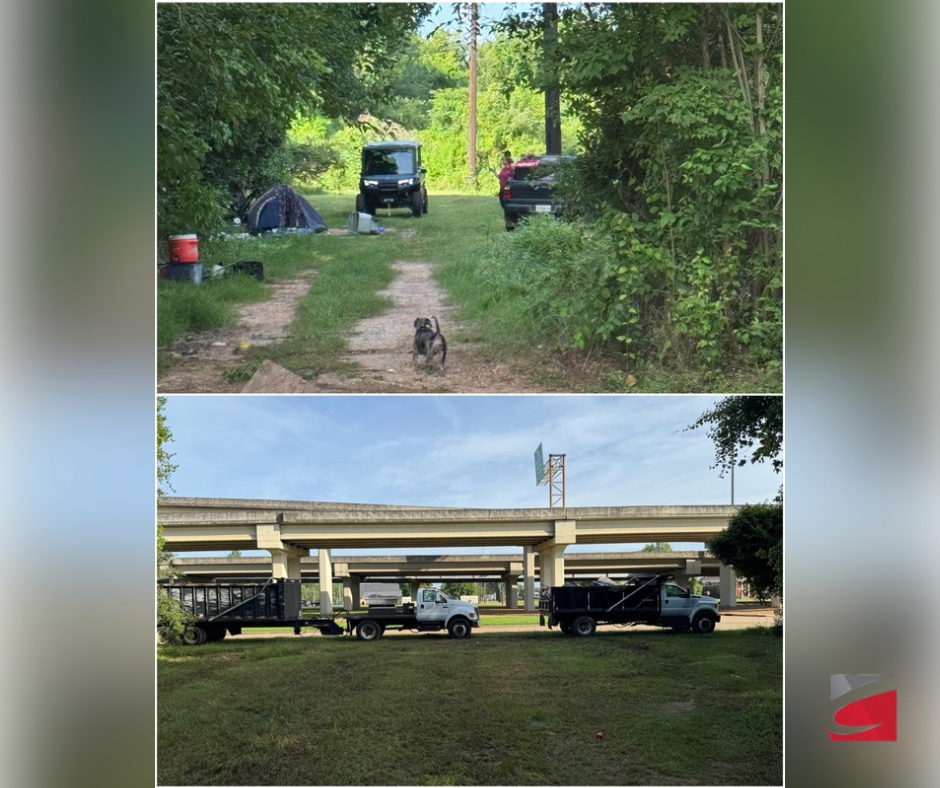
ALEXANDRIA, La. (UrbanCast: 6/29/2026) — Seventy-two hours have passed since city crews cleared a homeless encampment beneath the Interstate 49 overpass.

The bulldozers are gone.
The tents are gone.
But one question remains.
Where did the people go?
Last Friday, UrbanCast documented the cleanup as displaced residents gathered plastic bins, backpacks, bicycles, dogs, and the few belongings they could carry before quietly walking away from the encampment.
Three days later, several questions remain unanswered.
How many people entered transitional housing?
How many accepted services?
How many declined assistance?
How many simply relocated to another wooded area or another encampment?
Those answers matter because they help the public understand whether the cleanup resulted in people finding stability—or simply another place to sleep.
During Friday’s 11 a.m. briefing, Alexandria Police Chief Chad Gremillion explained why the city cleared the encampment.
He described it as a public safety and public health concern, citing sanitation issues, infrastructure damage, drug activity, and crime. He also said officers provided advance notice before the cleanup and that transitional housing resources are available, although individuals must complete intake requirements before entering those programs.
Chief Gremillion also revealed that this was not the first encampment the city had dismantled.
He said city departments cleared another encampment approximately six months ago along the Bayou Rapides green space walking trail, describing that location as another public safety and public health concern.

This Is Not The First Encampment
“This is not the first encampment that we’ve cleaned up. This just happens to be the first one people are talking about.” - Gremillion
That statement raises additional questions.
How many people were displaced during the Bayou Rapides cleanup?
Where did they go?
How many entered housing or supportive services?
How many eventually returned to homelessness?
Those figures were not discussed during Friday’s briefing.
Mayor Jacques Roy said homelessness cannot be solved through law enforcement alone.
He described the issue as involving public safety, public health, mental health, addiction, housing, and quality of life. He called for a coordinated response involving government agencies, healthcare providers, nonprofits, churches, and community organizations.
The briefing clearly answered one question.
Why did the city clear the Interstate 49 encampment?
It offered fewer details about what happened after residents walked away.
If another encampment was cleared months ago with little public discussion, then the total number of people displaced through recent encampment removals has not been publicly identified. Likewise, it remains unclear how many people from either encampment entered housing, connected with services, or relocated elsewhere.
Those are outcome questions.
Those are outcome questions.
They matter because they help the public evaluate whether the city’s efforts are achieving their intended goals.
The issue facing Alexandria is not unique.
According to reporting by Lafayette News 15, Lafayette Consolidated Government is preparing for Louisiana’s new anti-camping law by publicly discussing both enforcement and the challenges that remain.
Officials there have acknowledged that more than 200 people remain unsheltered. They have identified the need for additional shelter beds, supportive housing, coordinated services, and a pilot program designed to connect people experiencing homelessness with housing, healthcare, and other support services.
Lafayette officials have also openly discussed the financial realities.
“The intent of the law is good. It wants to try to reduce recidivism for homeless people, try to get them access to treatment programs; it just doesn’t come with any funding,” Christina Dayries, chief of staff for Lafayette Mayor-President Monique Blanco Boulet, told Lafayette News 15.
According to Lafayette News 15, officials are also exploring whether designated public green space with restroom facilities could provide a temporary, legal place for people experiencing homelessness while longer-term solutions are developed.
Alexandria and Lafayette are different communities with different resources, populations, and challenges.
This is not a comparison of which city has the better solution.
It is a comparison of the questions being asked.
In Alexandria, the public briefing focused on why the encampment was cleared.
In Lafayette, according to Lafayette News 15, officials are also publicly discussing how they intend to address what comes after enforcement.
As Alexandria continues developing its response to homelessness, another conversation naturally follows.
Not simply why encampments are cleared.
But what happens to the people afterward.
Ultimately, the measure of success is not simply how many encampments disappear.
It is whether fewer people are living without stable housing.
Previous Article: They Packed What They Could Carry. One Question Remained: Where Do They Go Now?