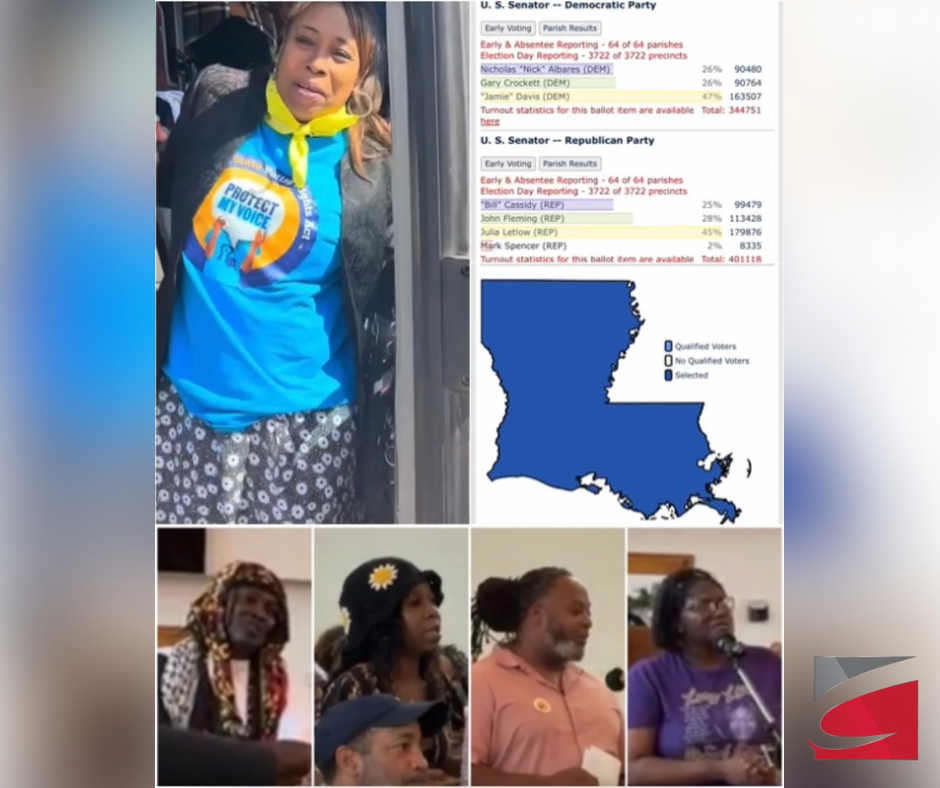
Alexandria, La. (5/17/2026) — Louisiana just showed again that millions of people are registered to vote, but a whole lot of them are not showing up.
Now the real question is this:
Do the people running politics and civic organizations actually want younger people involved, or are they comfortable keeping things the way they are because low turnout helps the same circles stay in control?

That’s the conversation a lot of people are scared to have honestly.
Look at the numbers.
Louisiana has almost 3 million qualified voters. But only around 400,000 people voted in the Republican Senate primary. Around 344,000 voted in the Democratic primary.
That means most people stayed home.
Now every election cycle we hear the same thing:
“Y’all need to vote.”
“Your voice matters.”
“Get involved.”
But younger people are starting to ask:
“Involved in what exactly?”
Because a lot of them feel like politics only comes around when somebody needs votes.
Frustration Came Out
That frustration came out recently during Congressman Cleo Fields’ town hall in Alexandria. Younger people in the room weren’t just frustrated with politicians. They were frustrated with the whole system around politics.
One young attendee basically said:
“We voted before. And things still didn’t get better.”
Another said politicians show up, cry with the community, pray with the community, promise change — then disappear after election season.
And honestly, a lot of people in the back of the room understood exactly what they meant.
Outside of the town hall itself, one frustrated resident later shared concerns that may further explain why many everyday people feel disconnected from political engagement efforts in the first place.
While discussing a recent trip to the Louisiana State Capitol surrounding the Senate vote on congressional redistricting lines, the resident said she would have attended herself had she even known the trip was happening.
Four Adults and One Chid Reportedly Made the Trip
Instead, she said only four adults and one child reportedly made the trip from the area.
According to the resident, the bigger problem was not the turnout itself, but how information seems to circulate through the same small connected circles.

“You have to be a part of some exclusive club, church, or organization to even know what’s going on,” she said.
The resident argued that issues involving congressional representation and voting rights should be pushed to the entire community aggressively and openly.
“When something this big is happening, everybody should know,” she said. “By any means necessary.”
In later conversations and direct messages, the resident questioned whether some outreach efforts are genuinely designed to mobilize large numbers of people or simply create the appearance of engagement.
For a lot of residents, especially younger people, the frustration is starting to feel less about voting itself and more about feeling excluded from the process unless they already belong to certain organizations, circles, churches, or networks.
Larger Question
And that’s where the larger question comes in.
Older voters are easier for political organizations to deal with.
They vote consistently.
They watch traditional news.
They attend civic meetings.
They’re easier to contact through churches, organizations, phone banks, and old-school campaign methods.
Political strategists know this.
So the question becomes:
If the current system already works for the people in power, how motivated are they really to change it?
Because reaching younger voters would require something different.
It would require politicians and organizations to stop talking at young people and start listening to them.
It would require showing up outside election season.
It would require transparency.
It would require accountability.

It would require meeting younger people where they actually are — online, in neighborhoods, through independent media, through culture, through real conversations.
Not just another flyer.
Not just another church speech.
Not just another election-year fish fry.
Consume Information Differently
Younger voters today consume information differently. A lot of them don’t trust traditional media, political organizations, or even longtime community leadership anymore.
And whether people want to admit it or not, some established political circles may quietly benefit from that disconnect.
Because when turnout stays low, smaller groups of reliable voters hold more power.
That’s just reality.
Now to be fair, some organizations probably do want younger people involved. But wanting it and actually changing how you operate are two different things.
A lot of these systems were built decades ago. Some leaders still communicate like it’s 1960 while younger people are living in an entirely different world.
Meanwhile, younger voters are saying:
“Stop telling us voting matters while ignoring us the rest of the year.”
Congressman Fields may have said the most important thing of the entire night.
“There are no apathetic voters. There are only uninspired voters.”
And maybe that’s the real story behind Louisiana’s low turnout.
Maybe people are not staying home because they don’t care.
Maybe they’re staying home because too many systems have failed to give them a reason to believe their involvement actually changes anything.
Related Article: Cleo Fields town hall reveals growing disconnect between younger voters and traditional political outreach